
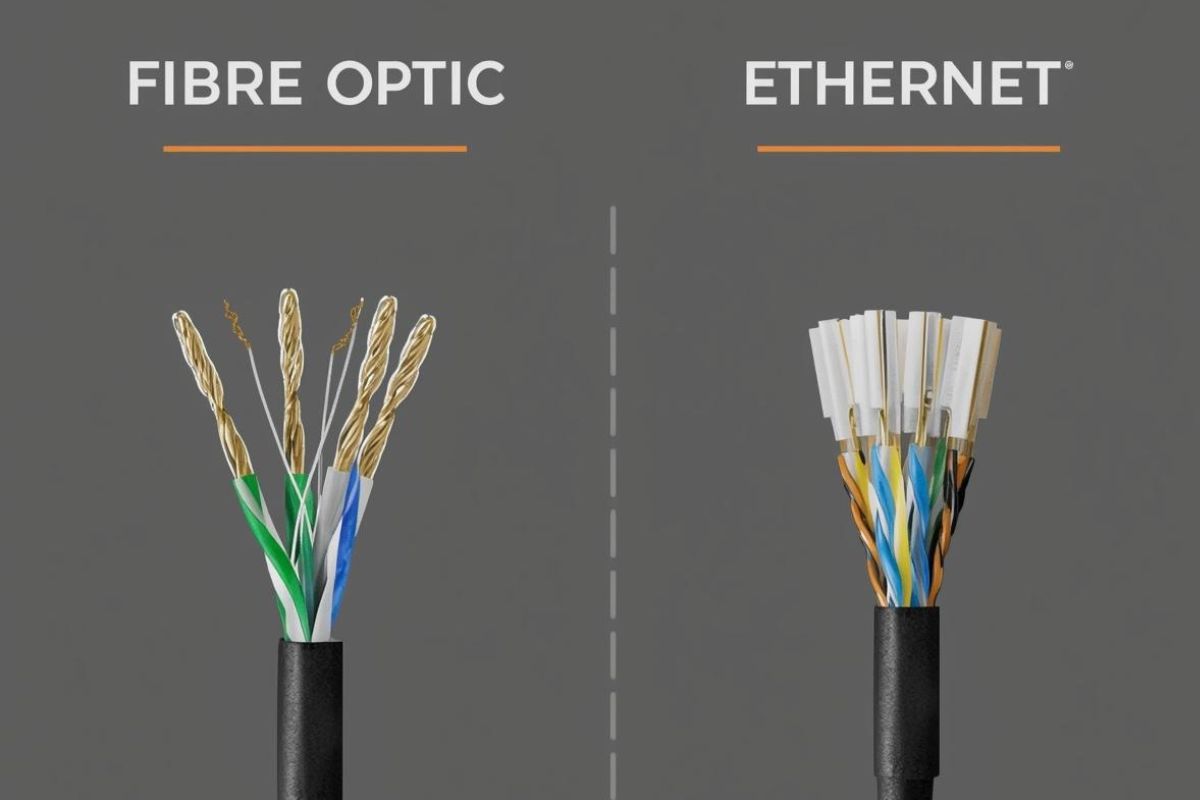
Fibre Optic vs. Ethernet: Which Is Best for Your Business Network?
Your network infrastructure is no longer just a technical concern, it’s a strategic asset. From cloud applications and video conferencing to cybersecurity and data analytics, nearly every business function depends on fast, reliable connectivity.
When designing or upgrading a business network, one of the most common questions decision-makers face is:
Should we use Fibre Optic or Ethernet?
While both technologies are widely used and often work together, they serve different purposes and offer distinct advantages and limitations. Choosing the wrong option or misunderstanding how they complement each other, can lead to performance bottlenecks, unnecessary costs, and scalability issues down the road.
This in-depth guide breaks down Fibre Optic vs. Ethernet, compares their performance, cost, scalability, and use cases, and helps you determine which is best for your business network.
Understanding the Basics
Before comparing the two, it’s important to understand what Fibre Optic and Ethernet actually are.
What Is Ethernet?
Ethernet is a local area network (LAN) technology that connects devices within a building or campus using copper cables, most commonly twisted-pair cables such as Cat5e, Cat6, Cat6a, or Cat7.
Ethernet is typically used to connect:
- Computers
- Printers
- IP phones
- Network switches
- Servers
Ethernet has been the standard for business networking for decades due to its reliability, affordability, and ease of installation.
What Is Fibre Optic?
Fibre optic technology uses thin strands of glass or plastic to transmit data as pulses of light. Instead of electrical signals (as used in Ethernet),fibre uses optical signals, allowing data to travel much faster and farther with minimal loss.
Fibre is commonly used for:
- Internet service provider (ISP) connections
- Data centers
- Inter-building connections
- High-speed enterprise backbones
Key Differences Between Fibre Optic vs. Ethernet
| Feature | Ethernet (Copper) | Fibre Optic |
| Transmission Medium | Electrical signals | Light signals |
| Speed | Up to 10 Gbps (typical) | 1 Gbps to 100+ Gbps |
| Distance Limit | ~100 meters | Several kilometers |
| Interference | Susceptible to EMI | Immune to EMI |
| Cost | Lower upfront | Higher upfront |
| Security | Easier to tap | Very difficult to tap |
| Scalability | Limited | Extremely scalable |
Performance Comparison
1. Speed and Bandwidth
Ethernet
- Standard Ethernet speeds range from 1 Gbps to 10 Gbps
- Suitable for most small to medium-sized businesses
- Performance can degrade over long distances or with interference
Fibre Optic
- Supports 10 Gbps, 40 Gbps, 100 Gbps, and beyond
- Ideal for bandwidth-intensive applications like:
- Cloud computing
- Video streaming
- Large data transfers
- Virtual desktops (VDI)
Winner: Fibre Optic, If speed and future-proofing are priorities, fibre clearly outperforms Ethernet.
2. Distance Limitations
Ethernet
- Maximum reliable distance is 100 meters (328 feet)
- Beyond that, signal degradation occurs
- Requires repeaters or switches for longer runs
Fibre Optic
- Can transmit data over kilometers without signal loss
- Perfect for:
- Large campuses
- Warehouses
- Multi-building facilities
Winner: Fibre Optic
3. Reliability and Interference
Ethernet
- Susceptible to:
- Electromagnetic interference (EMI)
- Radio frequency interference (RFI)
- Can be affected by nearby machinery, power lines, or fluorescent lighting
Fibre Optic
- Immune to EMI and RFI
- Performs consistently in industrial and high-noise environments
Winner: Fibre Optic
Cost Considerations
Initial Installation Cost
Ethernet
- Lower material costs
- Easier and faster installation
- Minimal specialized equipment required
Fibre Optic
- Higher cable and equipment costs
- Requires skilled technicians for installation and splicing
- Optical transceivers add to expense
Winner: Ethernet (for upfront cost)
Long-Term Cost and ROI
While Ethernet is cheaper initially, fibre often delivers better long-term value:
- Less maintenance
- Longer lifespan
- Supports future upgrades without replacing cables
Winner: Fibre Optic (long-term ROI)
Scalability and Future-Proofing
As businesses grow, so do their network demands.
Ethernet
- Limited upgrade potential
- May require cable replacement to support higher speeds
Fibre Optic
- Designed for future expansion
- Same fibre cables can support higher speeds with upgraded equipment
Winner: Fibre Optic
Security Considerations
Ethernet
- Electrical signals can be tapped without detection
- More vulnerable in high-security environments
Fibre Optic
- Extremely difficult to intercept without physical damage
- Ideal for businesses handling:
- Financial data
- Healthcare records
- Government or legal information
Winner: Fibre Optic
Common Business Use Cases
When Ethernet Is the Best Choice
Ethernet is ideal for:
- Small offices
- Retail stores
- Budget-conscious businesses
- Internal device connections
- Short-distance networking
Example: A 20-person office with standard internet usage, printers, and VoIP phones will function perfectly on Ethernet.
When Fibre Optic Is the Best Choice
Fibre is best for:
- Medium to large enterprises
- Data centers
- Campuses with multiple buildings
- High-speed internet access
- Cloud-heavy operations
Example: A company using cloud ERP systems, daily video conferencing, and large data transfers will benefit significantly from fibre.
Hybrid Networks: The Best of Both Worlds
Most modern businesses don’t choose Fibre vs. Ethernet, they use both.
A common setup includes:
- Fibre optic backbone for:
- Internet connection
- Inter-floor or inter-building links
- Ethernet connections for:
- Workstations
- Printers
- IP phones
This hybrid approach balances performance, cost, and flexibility.
Environmental and Power Efficiency
Fibre Optic
- Uses less power for data transmission
- Produces less heat
- More environmentally friendly for large-scale networks
Ethernet
- Consumes more power over long distances
- Generates more heat in dense installations
Which Is Best for Your Business Network (Fibre Optic or Ethernet)?
Choose Ethernet if:
- You have a small or medium office
- Budget is a major concern
- Network distances are short
- Bandwidth needs are moderate
Choose Fibre Optic if:
- You need high speed and low latency
- You’re planning for future growth
- You operate across large spaces
- Security and reliability are critical
Final Verdict
Fibre Optic cabling is the superior technology in terms of speed, reliability, security, and scalability, but Ethernet remains a practical, cost-effective solution for many businesses.
The best choice depends on your:
- Business size
- Budget
- Performance requirements
- Growth plans
For most organizations, a hybrid network combining finre and Ethernet offers the ideal balance.